ISPE FOYA 2026: Pharma 4.0 Facility Architecture
On 19 October 2026, ISPE named Sanofi the 2026 ISPE FOYA Overall Winner for its Modulus project — two modular biologics and vaccine facilities built in parallel at Neuville-sur-Saône, France and Tuas, Singapore. This year's cycle spans ten award categories but only nine facilities: Bayer's SOLIDA-1 in Leverkusen won both Pharma 4.0™ and Operations – Operational Excellence.
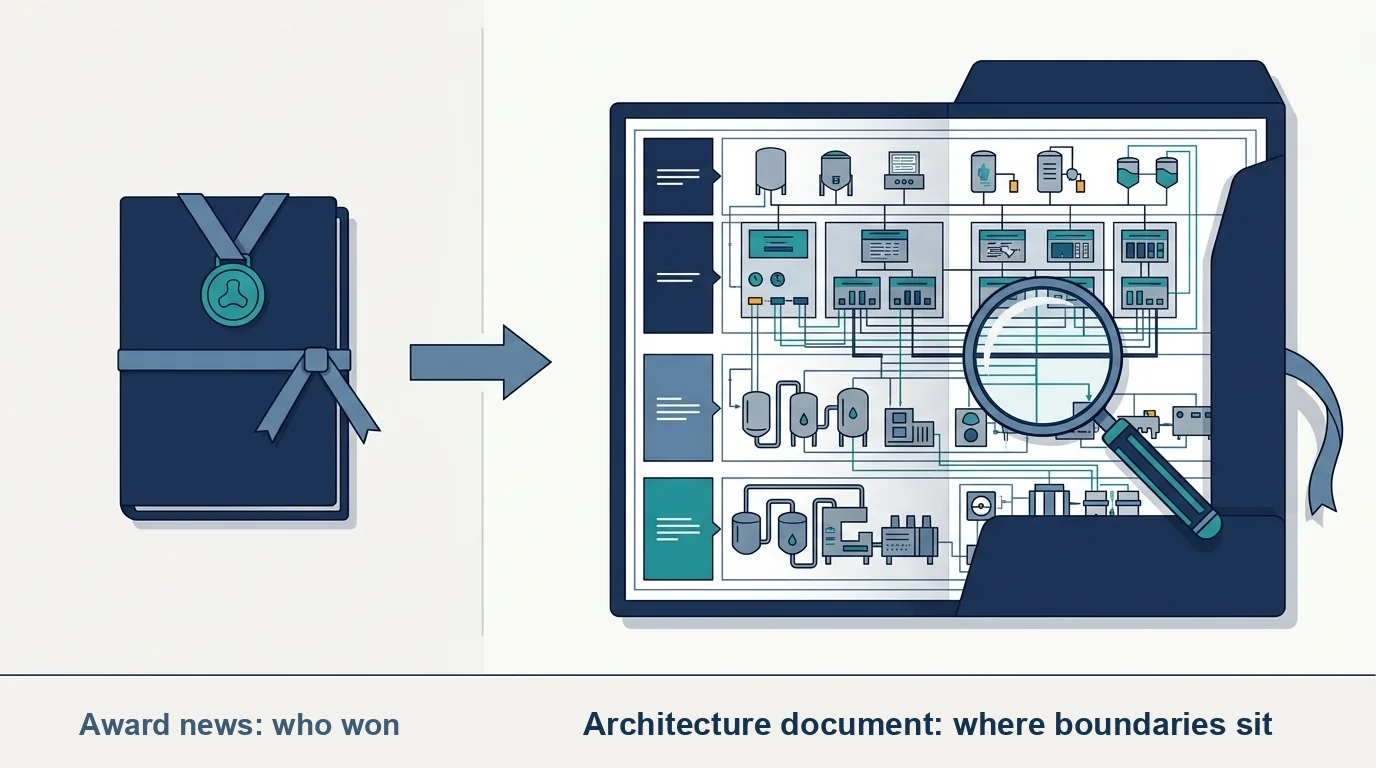
This article does not retell award news. ISPE's ten published submissions, read with an engineer's eye, form a rare document set: the nine most advanced facilities in the industry describing, in their own words, where they placed ISA-95 boundaries, how they reduced CSV validation load, and how they brought AI and digital twins into GMP operation. This piece decomposes the published technical facts into a comparable architecture matrix — something trade coverage so far has only presented as scattered prose.
Every figure in this article — capacity, percent savings, days of virtual testing — is a fact declared by the applicant in its FOYA submission and published publicly by ISPE, with a link back to each facility's official winner page. These are not independently audited numbers; the value of this article lies in how the architecture is read, not in praising the figures.
What this article gives you:
- All nine FOYA 2026 facilities in one matrix: dosage form, OT/IT highlights per ISA-95 layer, CSV/data-integrity strategy, published figures
- The three recurring design patterns that reduce validation load — and why they work
- A clear split between what a Southeast Asian plant upgrading from WHO-GMP to EU-GMP can apply now and what it should not attempt yet
- A 2026 reference frame when re-reading the foundation articles on the ISA-95 roadmap, MES/EBR validation and digital twins
Reading FOYA as architecture documents, not award news
This section sets the reading frame: each winning submission is a set of architecture decisions the industry has already filtered.
Regulatory baseline: the architecture analysis in this article is benchmarked against ISA-95, ISPE GAMP 5 Second Edition, 21 CFR Part 11 and EU GMP Annex 11.
FOYA — ISPE's Facility of the Year Awards, running since 2005 — is usually retold by the press as a list of plants and contractors. But ISPE's published announcements for the 2026 cycle contain enough technical facts to answer the question facility teams in Southeast Asia actually care about: when deploying MES/eBR, digital twins or AI in a GMP environment, where do the winners draw the responsibility boundaries between systems, and which part of that decision lightens the validation burden? The reading frame is ISA-95 — from Level 4 (ERP/supply chain) down to Level 3 (MES/eBR), Levels 1–2 (control/edge) and Level 0 (utilities, power) — through the GAMP 5 Second Edition lens of risk-based validation.
One caveat on evidence: ISPE publishes submission summaries only — not P&IDs, URS documents or detailed network architectures. This article stays close to the published facts, analyzes at the architecture level, and does not infer the internal configuration of any facility.
The nine-facility, ten-award FOYA 2026 matrix
A summary of the nine facilities and ten awards, then each facility in detail: dosage form, ISA-95-layered OT/IT highlights, CSV/data-integrity strategy and figures from the published submissions.
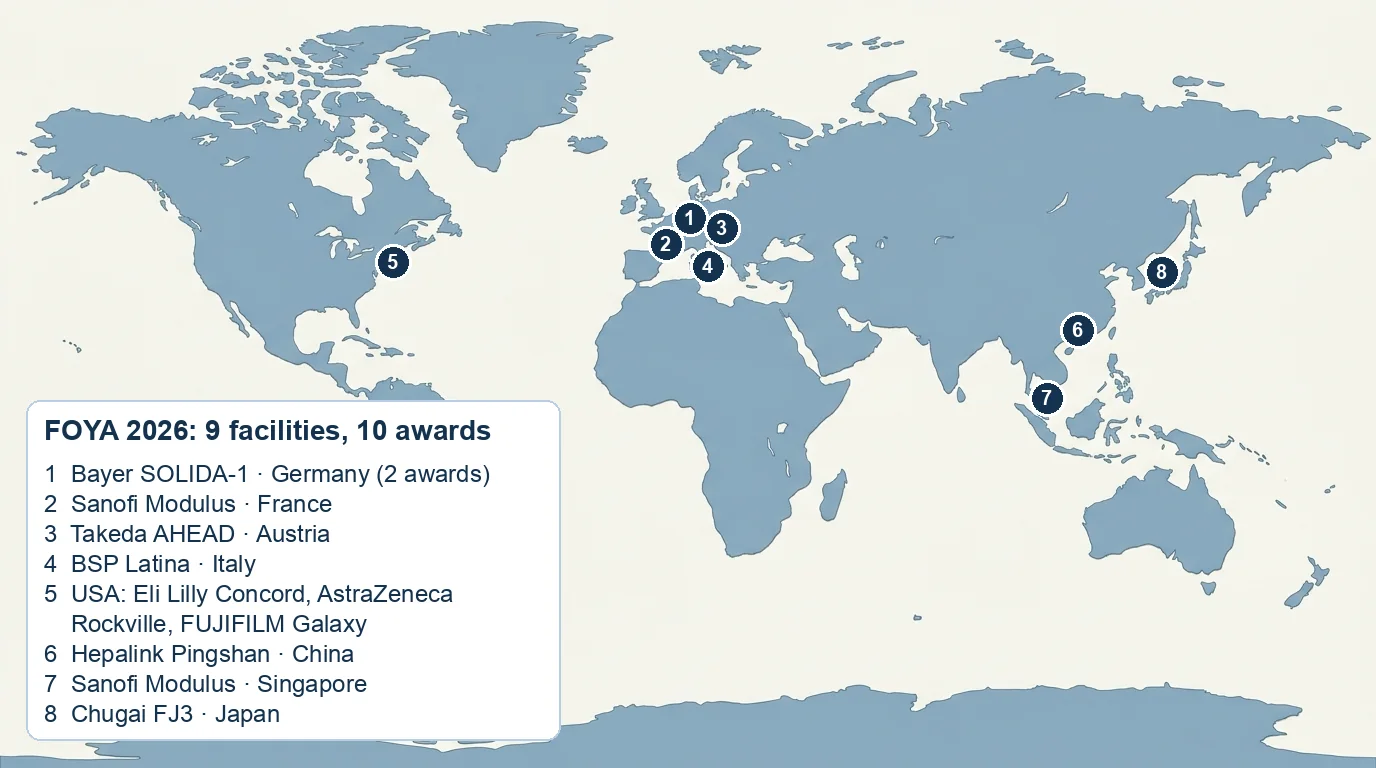
All figures in the table are taken from the FOYA 2026 submissions published by ISPE; each facility name links to that project's official winner page.
| Facility | Country | FOYA 2026 award | Architecture highlight |
|---|---|---|---|
| Bayer SOLIDA-1 | Germany | Pharma 4.0™ and Operational Excellence | MES on Kubernetes, recipes kept on the equipment |
| Eli Lilly Concord | USA | Project Execution | 250+ days of virtual testing on a digital twin |
| Hepalink Pingshan | China | Novel Technology | 5G edge, AI visual inspection |
| Sanofi Modulus | France, Singapore | Facility of the Future, Overall Winner | Plug-and-produce modular ballroom |
| Chugai FJ3 | Japan | Honorable Mention | End-to-end DCS–MES–WMS–ERP integration |
| BSP Pharmaceuticals Latina | Italy | Supply Chain | One quality system for the whole ADC chain |
| AstraZeneca Rockville | USA | Unmet Medical Needs | Power and utilities with no single point of failure |
| Takeda AHEAD | Austria | Sustainability Efforts | Heat pump making 11-bar steam from renewables |
| FUJIFILM Galaxy | USA | Honorable Mention | kojoX™ modular replication |
Facility details, through the same four lenses: dosage form, OT/IT highlights by ISA-95 layer, CSV and data-integrity strategy, and figures from the published submissions.
Bayer SOLIDA-1 · Germany
- Awards: Pharma 4.0™ and Operations – Operational Excellence, for the same project
- Dosage form: Oral solid dose, including high-potency compounds
- OT/IT by ISA-95 layer: MES running on a Kubernetes cluster (L3); validated recipes/setpoints kept at the equipment (L1–2); an orchestration layer extending the automation pyramid; AGV/robotics in the ballroom. Digital backbone connecting ERP to the shop floor near real time; automated modular formulation line with dedicated flow-control software
- CSV / data integrity: Equipment performs GMP-critical checks (e.g., identity check) itself before running; paperless validation; GenAI queries deviations/batch status in a read-data role. End-to-end data transparency presented as the foundation of data integrity
- Published figures: Declared capacity up to 1 billion tablets/year; architecture scales to 7 expansion modules, first module scheduled for 2027. Time-to-market cut 6–12 months; OEE +20%; operating staff −50%; CO₂ −90%/year via a reversible heat pump on renewable electricity plus geothermal
Eli Lilly Concord · USA
- Award: Operations – Project Execution
- Dosage form: Parenterals; paperless campus on a 415-acre greenfield site
- OT/IT by ISA-95 layer: Digital twin ran automation logic, HMI interactions and start-up sequences before equipment reached the site; central utility plant prefabricated as 25 modules
- CSV / data integrity: Replicated design platform and pre-qualified automation templates from the Research Triangle Park site (published submission) — cutting re-engineering and commissioning
- Published figures: Groundbreaking 06/2022 → FDA approval 12/2024 in 30 months; more than 250 days of virtual testing; on-floor testing time cut by roughly half
Hepalink Pingshan · China
- Award: Innovation – Novel Technology
- Dosage form: High-viscosity pre-filled syringes
- OT/IT by ISA-95 layer: 5G edge-computing infrastructure with <10 ms latency (L1–2) (published submission); AGVs + VHP chambers moving materials touch-free to Grade A isolators; deep-learning AI visual inspection; digital twin linking the Pingshan–Nanshan sites
- CSV / data integrity: EU-GMP certified; a 24 m automated warehouse embedded into the plant core
- Published figures: 330 million units/year on 297,715 sq ft; AI inspects 24,000 units/hour; first media fill at 100%; BMS chilled-water storage cuts energy per unit 18%, saving about USD 560,000/year; 703 days without a lost-time accident
Sanofi Modulus · France, Singapore
- Award: Innovation – Facility of the Future (also Overall Winner)
- Dosage form: Multi-platform vaccines and biologics: mRNA, viral vector, recombinant protein, enzyme, monoclonal antibody
- OT/IT by ISA-95 layer: Plug-and-produce modular ballroom: standardized docking stations with ready utility/data/control interfaces; mobile vapor-injection walls + dynamic HVAC zoning; MES–DCS–LIMS–robotics converged on a digital-twin platform
- CSV / data integrity: Digital twin for real-time monitoring and predictive maintenance; submission emphasizes data integrity and rapid issue tracing
- Published figures: Product changeovers measured in days rather than months; two sites built in parallel — Singapore runs enzyme, France runs mRNA — proving replicability
Chugai FJ3 · Japan
- Award: Honorable Mention
- Dosage form: Small-molecule API + mid-size cyclic peptides (liquid-phase synthesis)
- OT/IT by ISA-95 layer: DCS–MES–WMS–ERP integration reducing manual operations, supporting remote monitoring and digital-twin readiness
- CSV / data integrity: Completed 11/2024; high-potency containment at 0.03 µg/m³ — 40% better than the award-winning FJ2 facility; seismic isolation at Japan's highest rating
- Published figures: Two API technology platforms in a single integrated equipment configuration
BSP Pharmaceuticals Latina · Italy
- Award: Supply Chain
- Dosage form: ADC (antibody-drug conjugate): DS conjugation + aseptic DP fill-finish
- OT/IT by ISA-95 layer: Consolidated a multi-site chain into one facility: toxins, antibodies, conjugation, fill-finish and storage down to −80 °C co-located
- CSV / data integrity: One quality system from IND to commercial; a GLP suite inside the GMP core — early-phase toxic batches run on the same commercial equipment, removing the tech-transfer/re-validation burden
- Published figures: Conjugation capacity 40 g–15 kg (published submission); OEL below 10 ng/m³; LTIR 0.14 over 1.4 million man-hours; 100% renewable electricity, energy −18% in 3 years
AstraZeneca Rockville · USA
- Award: Social Impact – Unmet Medical Needs
- Dosage form: Autologous T-cell therapy — each batch belongs to one patient
- OT/IT by ISA-95 layer: A Level 0/1 problem: eliminate every single point of failure in power, mechanical, automation and utilities; a fully electrified plant
- CSV / data integrity: Quantitative risk assessment and layer-of-protection analysis borrowed from nuclear power, oil refining and Tier IV data centers
- Published figures: 105,000 sq ft serving up to 4,000 patients/year; mandatory 100% uptime — no facility-wide maintenance shutdowns; designed probability of total power loss below 1 event in 10,000 years; net-zero operational carbon, energy and water −50%
Takeda AHEAD · Austria
- Award: Social Impact – Sustainability Efforts
- Dosage form: Plant utilities — high-pressure steam for GMP production
- OT/IT by ISA-95 layer: Industrial heat pump producing 11-bar, >200 °C steam from 100% renewable electricity and natural refrigerant; waste-heat recovery from the existing chiller plant; simulation + real-time monitoring on Pharma 4.0 principles
- CSV / data integrity: Runs as a real utility for more than 7 months/year — not a pilot; flammable-refrigerant safety resolved by engineering and governance
- Published figures: Completed 09/2025; cuts up to 80% of CO₂, equivalent to about 1,600 tonnes/year; deliberately left unpatented so the industry can replicate
FUJIFILM Galaxy · USA
- Award: Honorable Mention
- Dosage form: Large-scale biologics — monoclonal antibodies (mAb)
- OT/IT by ISA-95 layer: kojoX™ modular-replication strategy "design once, build many": standardized layout, equipment and process; digital twin; 4D construction simulation, progress tracked with AI and drones
- CSV / data integrity: Digital replication reduces redesign effort, supplier design time and cross-site execution risk
- Published figures: Two DS buildings, each with four 20,000 L bioreactors; more than 13 million construction man-hours with a standout safety record; targeting LEED Gold
Placing the nine facilities on the ISA-95 layers
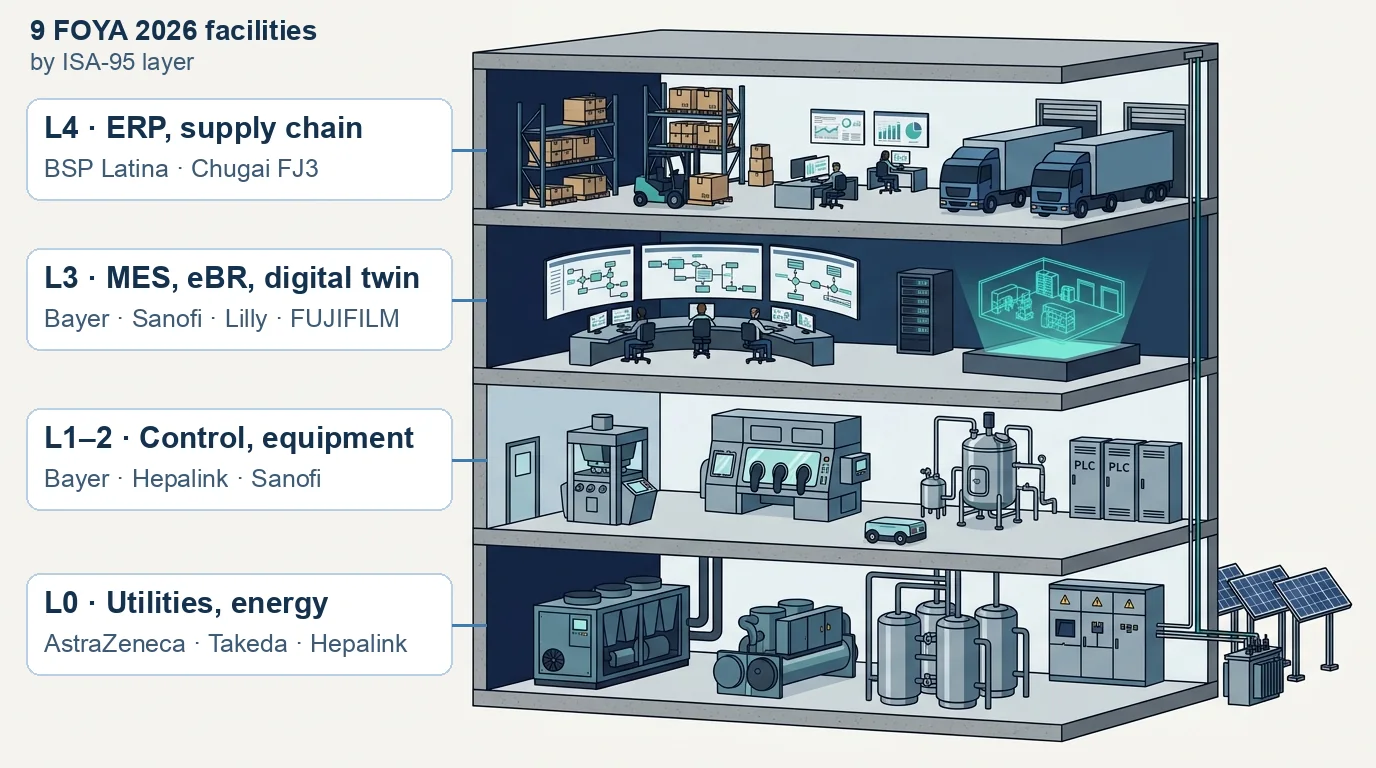
The diagram below places each project on the layer where its architecture decision does the work — a facility can appear on two layers when its strength sits at a boundary.
Read layer by layer, a simple fact emerges: no facility won on "more technology." Each project picked one architecture boundary to master — Bayer chose the MES–equipment boundary, Sanofi chose the utility interface, AstraZeneca chose the power layer. That is the same reading the ISA-95 implementation roadmap on this site proposes: value sits at a well-defined boundary, not in the number of systems installed.
Three design patterns that cut CSV load in FOYA 2026
Reading across the nine submissions, three architecture decisions repeat as a pattern — each one cutting part of the validation cost along risk-based thinking.
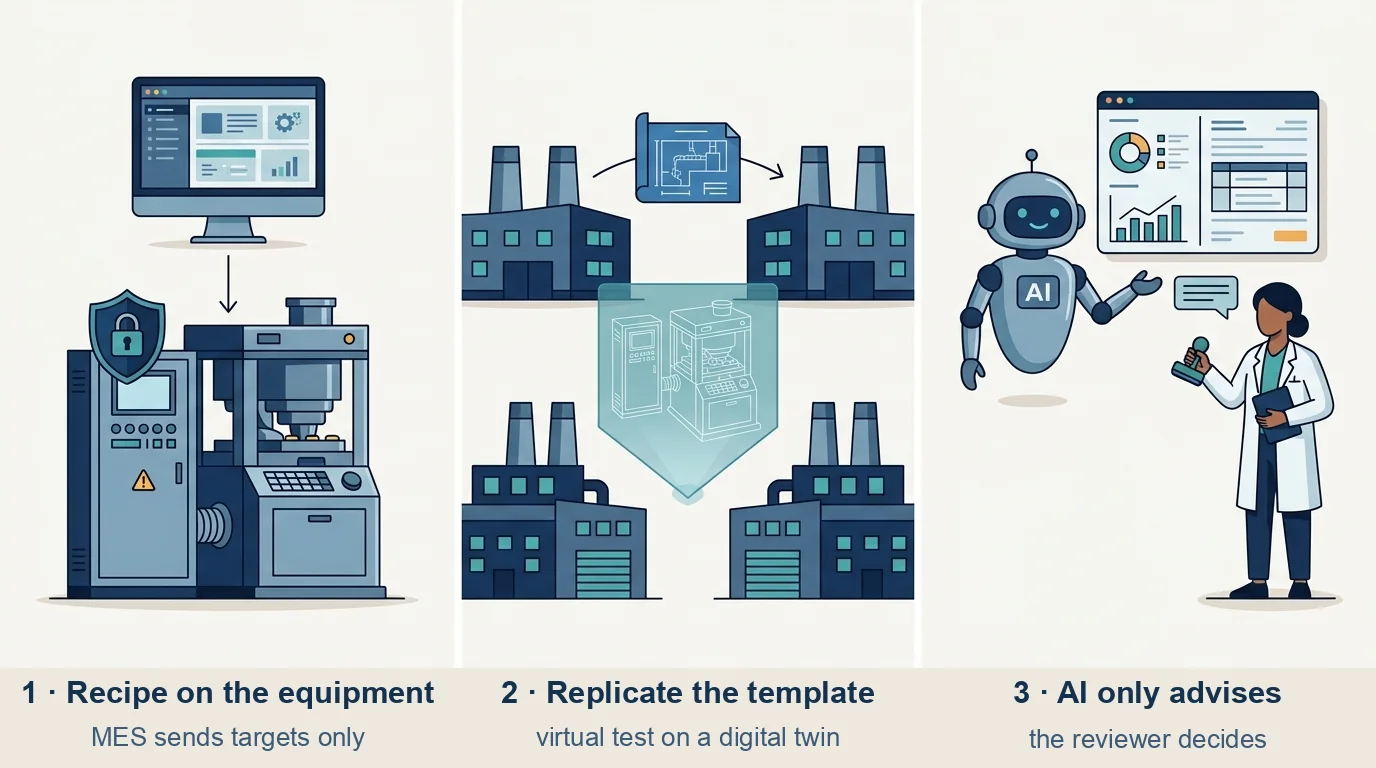
Pattern 1 — Keep the validated recipe on the equipment; MES sends only target parameters
According to the FOYA 2026 submission published by ISPE for Bayer SOLIDA-1, validated recipes/setpoints sit directly on the process equipment (L1–2); the MES at Level 3 supplies only target parameters, while the equipment itself performs GMP-critical checks — identity verification, for example — before execution. In validation terms this is an expensive boundary decision done right: when the MES is upgraded or changed, the validated control logic below it stays out of the re-validation scope. It is real-world proof of the principle in the MES/EBR selection guide: placing the right responsibility boundary is the most durable way to shrink CSV scope.
Pattern 2 — Replicate pre-qualified templates and test virtually on a digital twin
Eli Lilly Concord went from groundbreaking to FDA approval in 30 months — per the project's published winner page — using two levers: replicating a design platform and pre-qualified automation templates from a previous site, and running more than 250 days of virtual testing of automation logic, HMI and start-up sequences on a digital twin before equipment arrived, cutting on-floor testing time roughly in half. FUJIFILM follows the same direction at site-fleet level with kojoX™ — standardize once, replicate across sites. Both are direct applications of supplier/template evidence reuse in risk-based validation: validate the template deeply once, then inherit rather than restart at each site.
Pattern 3 — AI in an advisory role, inside the control boundary
Both AI examples of the cycle sit inside a cautious boundary. At Bayer, GenAI provides natural-language access to deviation data, batch status and equipment state — a read/advisory layer, not a GMP decision-maker. At Hepalink Pingshan, deep-learning AI runs a visual-inspection machine at 24,000 units/hour — a vision problem whose output can be verified statistically. Both match the principle in the digital twin article: AI advises rather than decides, remains explainable rather than a black box, and stays inside a clearly validated scope.
Where the FOYA 2026 digital twins sit in the classification
Four projects use digital twins in four different positions — a live illustration of the prototype / instance / aggregate classification.
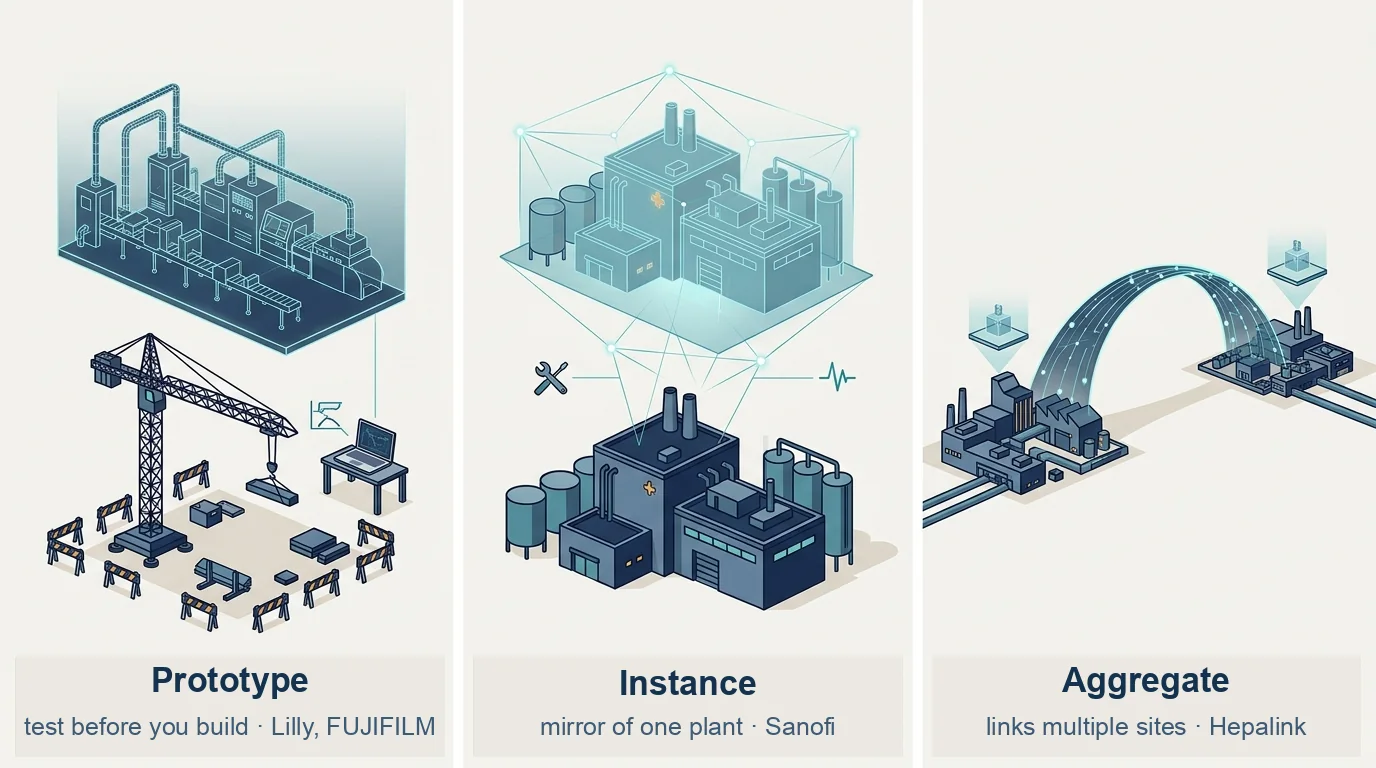
- Digital Twin Prototype — test before you build: Lilly Concord used a twin to run automation logic and HMI for more than 250 days before equipment arrived; FUJIFILM used a twin plus 4D simulation to raise first-pass design accuracy.
- Digital Twin Instance — a twin of one plant: Sanofi Modulus anchors both sites' digital architecture on a single digital-twin platform for real-time monitoring and predictive maintenance.
- Digital Twin Aggregate — linking multiple sites: Hepalink built a collaborative twin between Pingshan and Nanshan to transfer technical resources and production recipes quickly; Chugai FJ3 designed an integrated base ready for a twin deployment later.
This classification — and the boundary that "a digital twin does not replace validation" — is the core subject of the digital twin article, which now has a 2026 evidence set to benchmark against directly.
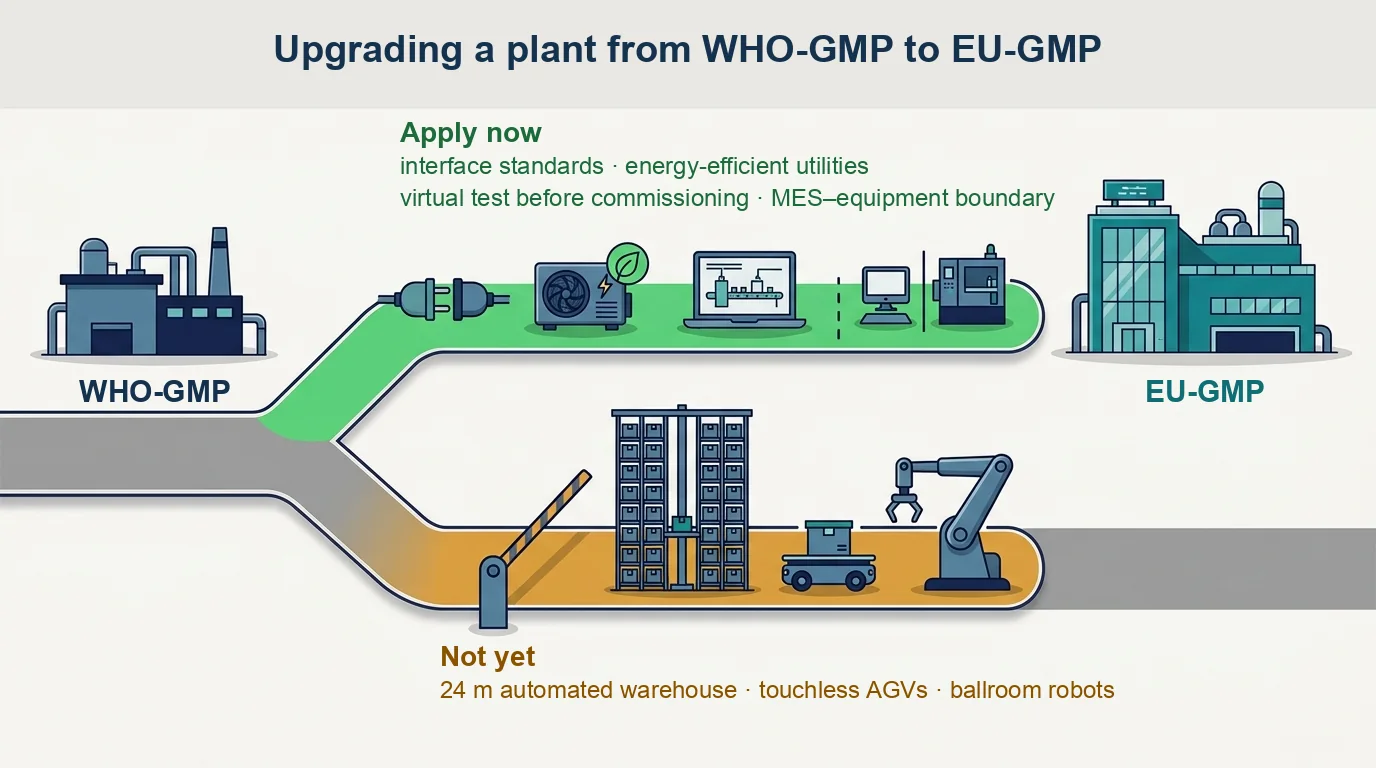
A Southeast Asian plant upgrading WHO-GMP → EU-GMP: apply now / not yet
The table below filters the FOYA matrix through the two closest reference frames: Sanofi Modulus Tuas (Singapore — close to the region geographically and in journey) and Hepalink Pingshan (EU-GMP certified on an Asian facility base).
| Architecture item | Apply now? | FOYA 2026 evidence and conditions |
|---|---|---|
| MES–equipment boundary split: validated recipes held at L1–2, MES sends parameters | Yes — do it from the start | Bayer SOLIDA-1: this is a design decision, not a capital-heavy one; writing it into the URS when selecting an MES avoids an expensive re-validation cycle later |
| Standardized utility/data/control interfaces in the docking-station style | Yes, at the interface-standard level | Sanofi Modulus: the part worth copying is interface discipline (standard connection points, standard data conventions); the ballroom + vapor-wall part demands a completely new build — not realistic for brownfield |
| Virtual automation-logic testing on a digital twin before commissioning | Yes, for new lines / major upgrades | Lilly Concord, FUJIFILM: only a twin at I/O-logic and sequence level is needed — not an enterprise platform; the biggest payoff is at FAT/commissioning |
| One quality system across phases / clinical→commercial at one site | Yes — if the business model fits | BSP Latina: a quality-architecture decision, not a software purchase; CDMO/multi-phase sites benefit immediately |
| BMS and utility-system energy optimization (chilled-water storage, HVAC zoning) | Yes — a quick win with clear ROI | Hepalink (−18% energy per unit), Takeda (heat pump), Sanofi (HVAC zoning): BMS/utility systems are less GMP-bound than the batch-decision layer — note that cleanroom EMS monitoring is GMP-critical and stays out of this quick-win scope; sensible to do first while eBR/MES is being prepared — see the ROI calculation |
| AI visual inspection / natural-language data querying | Cautious — controlled pilot | Hepalink (vision AI), Bayer (GenAI reading deviations): only in advisory/read-data roles or output-verifiable vision; never let AI make GMP decisions |
| 24 m automated warehouse, touchless AGV logistics, ballroom robotics | Not yet | Hepalink, Bayer: requires fully standardized underlying processes and very high throughput density; jumping in while operating records are still on paper creates risk rather than removing it |
| 100%-uptime requirement with no maintenance shutdowns | Not yet — except special products | AstraZeneca Rockville: only meaningful when the product cannot be stockpiled (cell therapy); for ordinary products, redundancy cost far outweighs the benefit |
The order most plants should follow remains the Pharma 4.0 sequence: computerization → connectivity → visibility → transparency → adaptability. FOYA 2026 shows that the top facilities passed through every one of those stages before ballrooms or "lights-out" made sense.
Three questions from the FOYA matrix to put straight into your URS
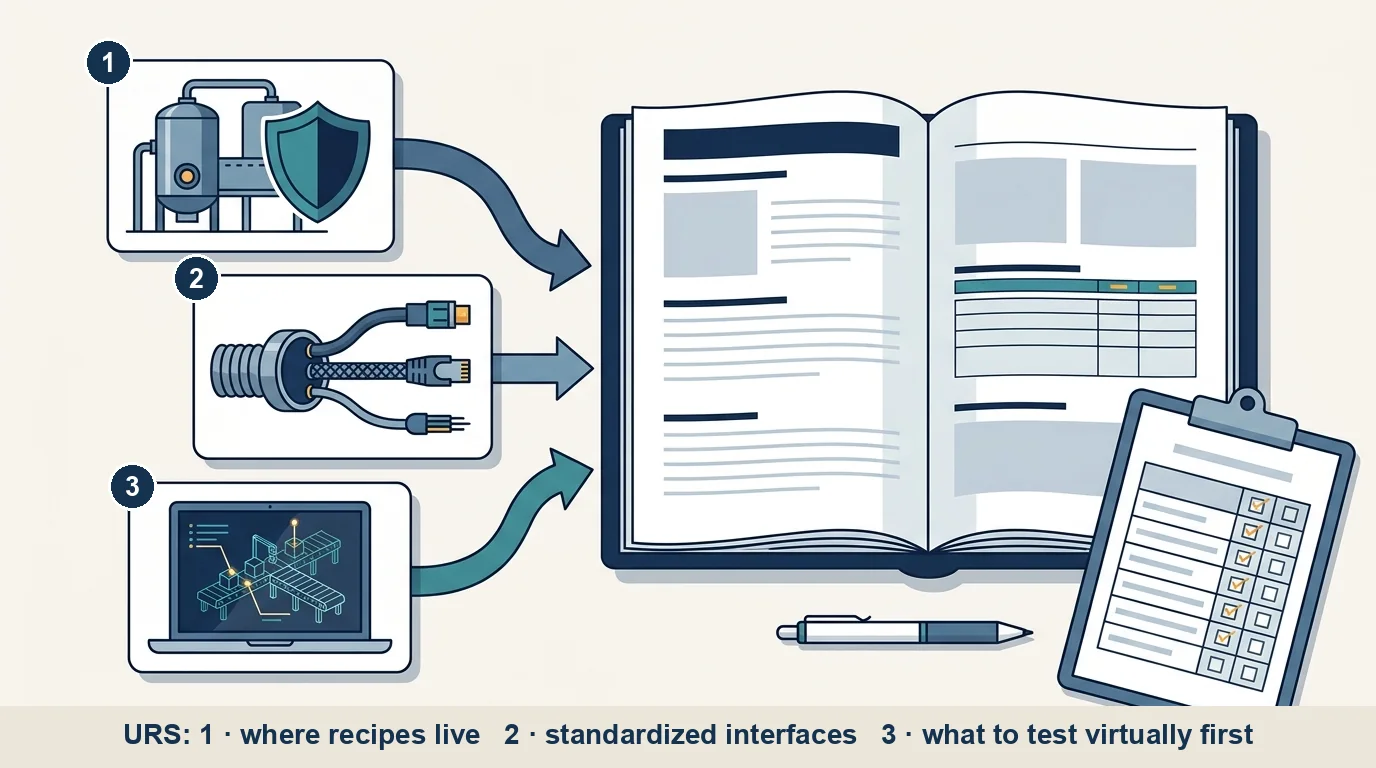
If your facility is drafting a URS for a 2026–2027 digitalization project, three questions deserve to be copied straight into the requirements document. One: which layer will hold the validated recipes/setpoints. Two: whether the utility–data–control interface is standardized as a single connection point. Three: which parts of the logic will be tested virtually before touching the production floor. Answering those three before choosing a vendor is the cheapest way to borrow the lessons of the nine winning facilities.
FAQ
Are the figures in this article as reliable as audited data?
No. All figures — capacity, percent savings, days of virtual testing — are facts declared by applicants in their FOYA submissions and published publicly by ISPE on each award's winner page. This article quotes them verbatim with source links; they are not independently measured by a third party.
Where should a WHO-GMP plant start learning from FOYA 2026?
From boundary discipline, not equipment. Three things are immediately actionable at low cost: place the MES–equipment boundary in the URS, standardize data interfaces between systems, and virtually test automation logic before commissioning. Robotics and ballrooms belong after operating records are stably digitalized.
Why does Bayer SOLIDA-1 count as two awards for one facility?
Because ISPE judges by category, not by facility. SOLIDA-1 won both Pharma 4.0™ and Operations – Operational Excellence for the same Leverkusen project — which is why the 2026 cycle has ten awards across nine facilities.
Is AI in the winning facilities allowed to make GMP decisions?
No — and the winning submissions describe it that way themselves. Bayer's GenAI reads deviation data and batch status in an advisory role; Hepalink's vision AI does visual inspection, a problem with verifiable output. GMP decisions still belong to people and validated processes.
Primary sources (published by ISPE)
- ISPE — Overall Winner announcement: Sanofi S.A. named 2026 ISPE FOYA Overall Winner for its Modulus project (PR Newswire, 19/10/2026).
- Official winner page for each category on ispe.org: Pharma 4.0™ — Bayer SOLIDA-1; Operations – Operational Excellence — Bayer SOLIDA-1; Operations – Project Execution — Eli Lilly Concord; Innovation – Novel Technology — Hepalink Pingshan; Innovation – Facility of the Future — Sanofi Modulus; Supply Chain — BSP Pharmaceuticals Latina; Social Impact – Unmet Medical Needs — AstraZeneca Rockville; Social Impact – Sustainability Efforts — Takeda AHEAD; Honorable Mention — Chugai FJ3; Honorable Mention — FUJIFILM Galaxy.
Reference frameworks
- ISA-95 — Enterprise-Control System Integration.
- ISPE GAMP 5 Second Edition — Risk-Based Approach to Compliant GxP Computerized Systems.
- FDA 21 CFR Part 11 — Electronic Records; Electronic Signatures; EU GMP Annex 11 — EudraLex Volume 4.
Methodology note and source limitations
- All facility figures in this article are quoted from submissions published publicly by ISPE on the winner pages listed under Primary sources; they are applicant-declared figures, not independently audited data.
- The ISA-95 layer analysis, the three CSV-load patterns and the apply-now table are the author's architectural interpretation of the published facts — not ISPE content.
- This article uses no imagery from ispe.org or real facility photos. The ISA-95 diagram is author-made; the illustrations are AI-generated from the author's descriptions, with English labels set by the author.
Note: This content is technical-architecture reference material and does not replace SOPs, validation plans or the official regulations of the local pharmaceutical authority.
Conclusion: benchmarks are for comparison, not a template to copy
The nine FOYA 2026 facilities share one trait: each project knows exactly where its system boundary sits — MES–equipment at Bayer, quality system at BSP, the power layer at AstraZeneca, the utility interface at Sanofi — and invests deeply in that one boundary instead of spreading technology thin. That is also the only lesson a WHO-GMP plant in Southeast Asia should copy verbatim: choose the boundary you need to master first; the technology comes after.
Decision moment
To turn these recommendations into a feasible implementation plan, see the ISA-95 architecture and MES/EBR implementation pages on this site — and the three foundation articles linked throughout: the ISA-95 implementation roadmap, EBR validation and deployment, and digital twins in pharma manufacturing.