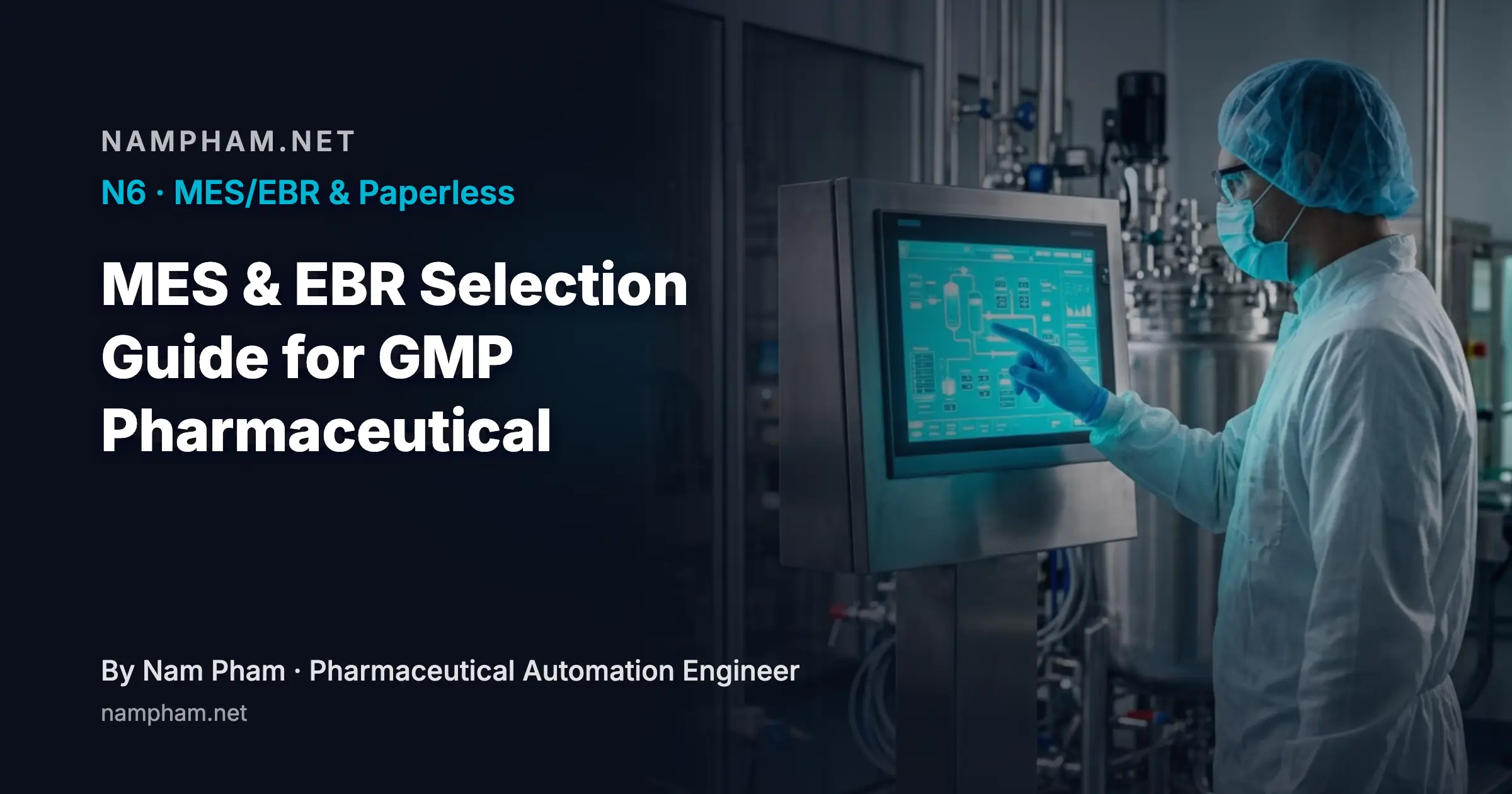
MES Pharma ROI Calculator: Building the Business Case for MES

TYPE 2 source note. This guide is practitioner-authored engineering guidance based on 10 years of hands-on GMP automation delivery.

Transparency note. NamPham.net writes from real pharma automation project experience. Regulatory citations link to official sources; verify the current revision with the issuing authority before applying to validated systems.

\n# MES Pharma ROI Calculator: Building the Business Case In pharmaceutical manufacturing, deploying a Manufacturing Execution System (MES) with an Electronic Batch Record (EBR) module is a multi-million dollar investment. Securing CapEx approval from the board of directors requires more than just qualitative arguments about "better compliance"—it requires a hard, quantified Return on Investment (ROI) calculation. Having engineered data architectures and evaluated MES vendors for tier-1 Pharma plants in Vietnam, I have developed a structured model to calculate MES ROI. ---

1. The Four Pillars of MES Pharma ROI Savings

An MES generates financial returns through four primary mechanisms: ```mermaid pie title MES Financial Impact Areas "Batch Review Time Reduction (EBR)" : 40 "Data Entry Error Prevention" : 30 "OEE & Throughput Increase" : 20 "Inventory Optimization" : 10 ``` ---

2. Quantifying the Savings (The MES Pharma ROI Formula)

### A. Batch Release Time (Review by Exception) In a paper-based plant, QA might spend 4-8 hours reviewing a 150-page batch record. With MES, "Review by Exception" highlights only the deviations. * **Calculation:** (Batches per year) × (Hours saved per batch) × (QA Hourly Rate). * **Example:** 1000 batches × 5 hours × $30/hr = **$150,000 / year**. ### B. Error Prevention (Right-First-Time) Paper records lead to missing signatures, calculation errors, or wrong material weighing. This causes deviations and potentially batch rejections. * **Calculation:** (Number of deviations per year) × (Cost to investigate one deviation) × (% reduced by MES). * **Example:** 200 deviations × $1,500/deviation × 60% reduction = **$180,000 / year**. ### C. OEE (Overall Equipment Effectiveness) MES provides real-time visibility into machine downtime, allowing faster maintenance response and optimized changeovers. * **Calculation:** (Annual Production Value) × (OEE % Increase) × (Profit Margin). * **Example:** $50M revenue × 2% OEE bump × 20% margin = **$200,000 / year**. ---

3. The Costs of Implementation (CapEx & OpEx)

When building the business case, you must account for the Total Cost of Ownership (TCO) over 5 years. | Cost Component | Type | Description | | :--- | :--- | :--- | | **Software Licenses** | CapEx / OpEx | Perpetual licenses or SaaS subscriptions (e.g., Tulip, Batchline, Rockwell). | | **Implementation Services** | CapEx | System Integrator fees (Process mapping, configuration, master batch record authoring). | | **Validation (CSV)** | CapEx | QA time and external consultants to execute IQ/OQ/PQ. | | **Hardware** | CapEx | Cleanroom tablets, barcode scanners, server infrastructure. | | **Maintenance & Support** | OpEx | Annual 15-20% software maintenance fee. | \n

Comprehensive Glossary and mes pharma roi Implementation Framework

To fully grasp the nuances of mes pharma roi, we must look at the exact definitions and operational parameters defined by international regulatory bodies. This section provides a deep dive into the theoretical framework backing up the operational strategies discussed above. ### 1. Regulatory Definitions When auditors look for mes pharma roi compliance, they operate on standardized definitions. - **Data Integrity (ALCOA+):** Data must be Attributable, Legible, Contemporaneous, Original, and Accurate. - **Audit Trails:** A metadata record that tracks who did what, when, and why. In the context of mes pharma roi, the audit trail is the definitive proof of control. - **Computerized System:** A system including the hardware, software, and network components, together with the controlled functions and associated documentation. ### 2. Standard Operating Procedures (SOPs) Checklist To ensure your mes pharma roi initiative succeeds, the following SOPs must be drafted, reviewed by QA, and rigorously enforced: 1. **User Access Management:** Defining how operators, supervisors, and administrators are granted and revoked access. 2. **System Backup and Restoration:** Detailing the frequency of backups, the storage medium (e.g., NAS, Cloud), and the procedure for testing restoration. 3. **Disaster Recovery (DR) and Business Continuity Planning (BCP):** How the plant will continue to operate if the mes pharma roi system goes offline. 4. **Incident and Deviation Management:** The exact steps to take when a data discrepancy is found in the mes pharma roi records. 5. **Periodic Review:** A scheduled assessment (typically every 12 to 24 months) to ensure the system remains in a validated state. ### 3. Training and Competency Management Deploying a new mes pharma roi system is only 20% technical. The remaining 80% is cultural change and personnel training. - **Initial Training:** All users must undergo classroom and hands-on training before being granted credentials. - **Competency Assessment:** Training is not complete until the user passes a practical competency test demonstrating they can use the system without violating GMP. - **Refresher Training:** Annual training to reinforce good data practices and introduce any system updates. ### 4. Vendor Assessment and Supply Chain For any mes pharma roi project, the software vendor must be audited. - **Supplier Audit:** Does the vendor have a robust QMS (Quality Management System)? Are they ISO 9001 certified? - **Agile vs. Waterfall:** Ensure the vendor's software development lifecycle (SDLC) aligns with GAMP 5 principles. - **Service Level Agreements (SLAs):** Define the response times for critical and non-critical system failures. By rigorously applying this framework, pharmaceutical manufacturers can ensure their mes pharma roi deployments are bulletproof against FDA and EU inspections.

Comprehensive Glossary and mes pharma roi Implementation Framework

To fully grasp the nuances of mes pharma roi, we must look at the exact definitions and operational parameters defined by international regulatory bodies. This section provides a deep dive into the theoretical framework backing up the operational strategies discussed above. ### 1. Regulatory Definitions When auditors look for mes pharma roi compliance, they operate on standardized definitions. - **Data Integrity (ALCOA+):** Data must be Attributable, Legible, Contemporaneous, Original, and Accurate. - **Audit Trails:** A metadata record that tracks who did what, when, and why. In the context of mes pharma roi, the audit trail is the definitive proof of control. - **Computerized System:** A system including the hardware, software, and network components, together with the controlled functions and associated documentation. ### 2. Standard Operating Procedures (SOPs) Checklist To ensure your mes pharma roi initiative succeeds, the following SOPs must be drafted, reviewed by QA, and rigorously enforced: 1. **User Access Management:** Defining how operators, supervisors, and administrators are granted and revoked access. 2. **System Backup and Restoration:** Detailing the frequency of backups, the storage medium (e.g., NAS, Cloud), and the procedure for testing restoration. 3. **Disaster Recovery (DR) and Business Continuity Planning (BCP):** How the plant will continue to operate if the mes pharma roi system goes offline. 4. **Incident and Deviation Management:** The exact steps to take when a data discrepancy is found in the mes pharma roi records. 5. **Periodic Review:** A scheduled assessment (typically every 12 to 24 months) to ensure the system remains in a validated state. ### 3. Training and Competency Management Deploying a new mes pharma roi system is only 20% technical. The remaining 80% is cultural change and personnel training. - **Initial Training:** All users must undergo classroom and hands-on training before being granted credentials. - **Competency Assessment:** Training is not complete until the user passes a practical competency test demonstrating they can use the system without violating GMP. - **Refresher Training:** Annual training to reinforce good data practices and introduce any system updates. ### 4. Vendor Assessment and Supply Chain For any mes pharma roi project, the software vendor must be audited. - **Supplier Audit:** Does the vendor have a robust QMS (Quality Management System)? Are they ISO 9001 certified? - **Agile vs. Waterfall:** Ensure the vendor's software development lifecycle (SDLC) aligns with GAMP 5 principles. - **Service Level Agreements (SLAs):** Define the response times for critical and non-critical system failures. By rigorously applying this framework, pharmaceutical manufacturers can ensure their mes pharma roi deployments are bulletproof against FDA and EU inspections.

Comprehensive Glossary and mes pharma roi Implementation Framework

To fully grasp the nuances of mes pharma roi, we must look at the exact definitions and operational parameters defined by international regulatory bodies. This section provides a deep dive into the theoretical framework backing up the operational strategies discussed above. ### 1. Regulatory Definitions When auditors look for mes pharma roi compliance, they operate on standardized definitions. - **Data Integrity (ALCOA+):** Data must be Attributable, Legible, Contemporaneous, Original, and Accurate. - **Audit Trails:** A metadata record that tracks who did what, when, and why. In the context of mes pharma roi, the audit trail is the definitive proof of control. - **Computerized System:** A system including the hardware, software, and network components, together with the controlled functions and associated documentation. ### 2. Standard Operating Procedures (SOPs) Checklist To ensure your mes pharma roi initiative succeeds, the following SOPs must be drafted, reviewed by QA, and rigorously enforced: 1. **User Access Management:** Defining how operators, supervisors, and administrators are granted and revoked access. 2. **System Backup and Restoration:** Detailing the frequency of backups, the storage medium (e.g., NAS, Cloud), and the procedure for testing restoration. 3. **Disaster Recovery (DR) and Business Continuity Planning (BCP):** How the plant will continue to operate if the mes pharma roi system goes offline. 4. **Incident and Deviation Management:** The exact steps to take when a data discrepancy is found in the mes pharma roi records. 5. **Periodic Review:** A scheduled assessment (typically every 12 to 24 months) to ensure the system remains in a validated state. ### 3. Training and Competency Management Deploying a new mes pharma roi system is only 20% technical. The remaining 80% is cultural change and personnel training. - **Initial Training:** All users must undergo classroom and hands-on training before being granted credentials. - **Competency Assessment:** Training is not complete until the user passes a practical competency test demonstrating they can use the system without violating GMP. - **Refresher Training:** Annual training to reinforce good data practices and introduce any system updates. ### 4. Vendor Assessment and Supply Chain For any mes pharma roi project, the software vendor must be audited. - **Supplier Audit:** Does the vendor have a robust QMS (Quality Management System)? Are they ISO 9001 certified? - **Agile vs. Waterfall:** Ensure the vendor's software development lifecycle (SDLC) aligns with GAMP 5 principles. - **Service Level Agreements (SLAs):** Define the response times for critical and non-critical system failures. By rigorously applying this framework, pharmaceutical manufacturers can ensure their mes pharma roi deployments are bulletproof against FDA and EU inspections.